
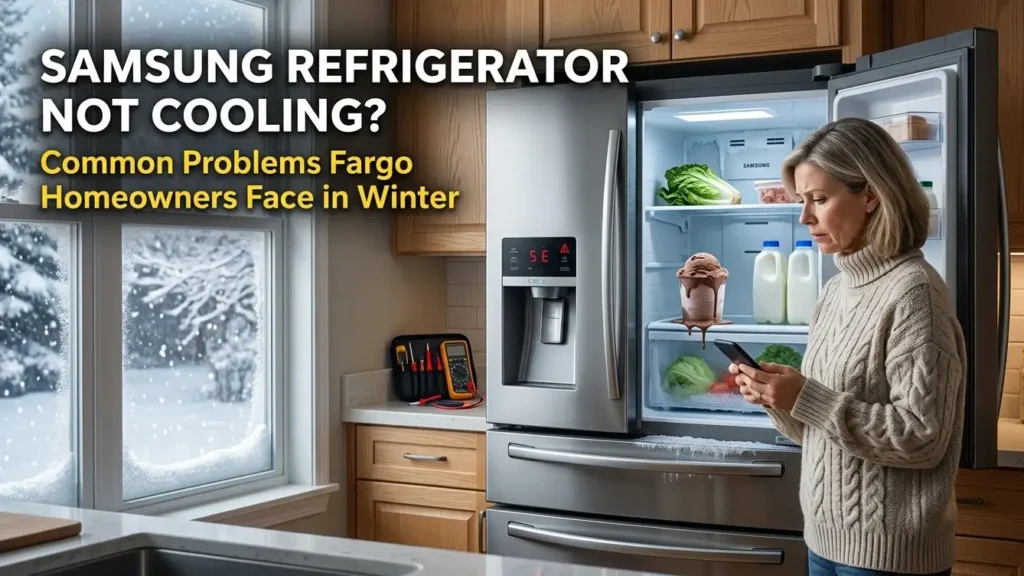
If your Samsung refrigerator is not cooling in Fargo, the most likely causes are a failed evaporator fan motor, ice buildup on the evaporator coils due to a defrost system failure, dirty condenser coils, a worn door gasket, or a faulty compressor. Fargo’s extreme winters can also place added stress on certain components, especially in refrigerators placed in garages or poorly insulated utility rooms. Most of these issues require a professional technician to diagnose and repair properly.
If you opened your Samsung fridge this morning only to find lukewarm leftovers and soft ice cream, you are not alone. This is one of the most frequent appliance complaints we hear from homeowners right here in Fargo, North Dakota. Samsung refrigerators are packed with smart features and modern engineering, but they come with a handful of recurring weak points that show up more often than the brand would probably like to admit. Understanding what is actually going wrong inside that refrigerator cabinet can save you both time and money, and help you make a smarter decision about whether to attempt a fix yourself or call in a professional.
This guide covers every major cause we see in Fargo homes, explains why the local climate plays a bigger role than most people realize, and gives you a clear picture of what a repair actually involves.
Why Fargo’s Climate Makes Samsung Refrigerator Problems Worse
Before diving into individual components, it is worth acknowledging something that most generic troubleshooting guides completely skip over: Fargo, North Dakota has one of the harshest temperature swings in the entire country. Winter lows regularly plunge well below zero, while summers push into the 90s. That kind of range puts unusual pressure on appliances.
When a refrigerator is placed in an unheated garage or space where the temperature drops below 36 degrees Fahrenheit, it may shut down and stop cooling entirely. This can cause food to thaw and warm inside the insulated cabinet, particularly in the freezer section. Many Fargo homeowners use a second Samsung fridge in the garage, basement, or utility room, and those placements become serious problems the moment the thermostat dips in late October.
On the flip side, environments that are too cold, below 55 degrees Fahrenheit, can cause the refrigerator to work harder to cool, which can reduce overall cooling performance. The refrigerant system in these units is calibrated for typical indoor ambient temperatures. When the surrounding air falls far outside that range, the compressor and control board begin behaving unpredictably.
This is not a reason to avoid Samsung refrigerators altogether. It is simply a reason to understand your specific environment and know what symptoms to watch for.
The Most Common Reasons Your Samsung Refrigerator Is Not Cooling
1. Evaporator Fan Failure
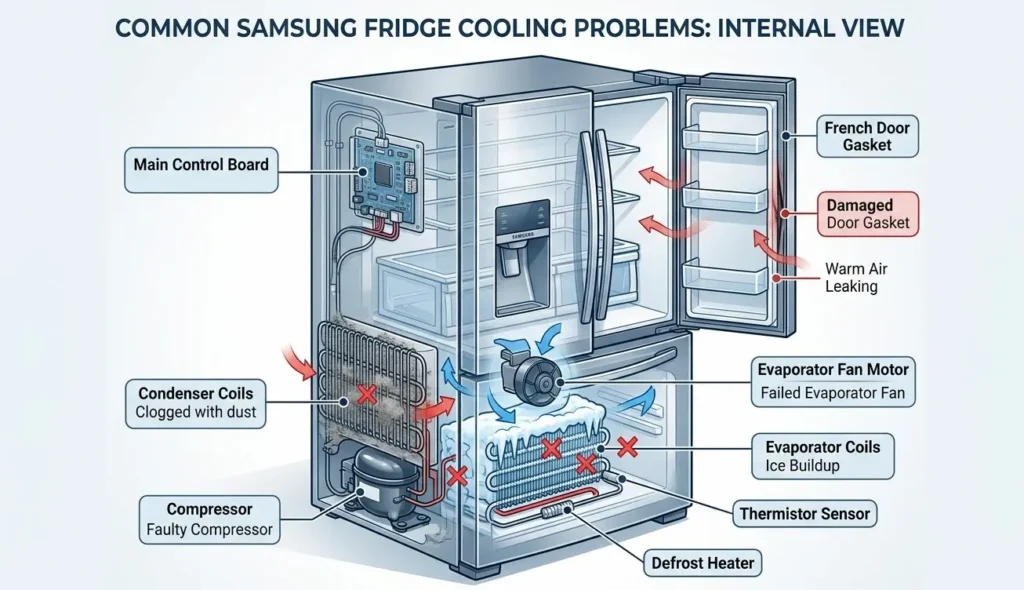
The evaporator fan is the component responsible for circulating cold air throughout both the refrigerator and freezer compartments. If the evaporator fan stops working, the fridge will not cool properly, but the freezer might still work. You will notice uneven cooling or a noisy refrigerator.
This is an extremely common failure pattern in Samsung units, particularly in the Twin Cooling Plus models like the RF28, RF23, and RF22 series. In those refrigerators, the fridge and freezer each have their own separate evaporator and fan. In a Samsung Twin Cooling Plus system, you will often see a situation where the freezer is freezing but the fridge is warm. One fan can be dead or iced over while the other continues to function normally.
If you press your ear close to the refrigerator section and hear nothing or hear a grinding noise, the evaporator fan is worth inspecting first.
2. Ice Buildup on the Evaporator Coils
This is arguably the single most common Samsung cooling complaint across the country, and Fargo homes are not immune. Ice buildup can block cold air circulation, causing the fridge to feel warm despite there being visible frost inside the unit. A frozen evaporator fan cannot distribute cold air when ice traps the blades.
The reason ice accumulates is almost always a failure in the automatic defrost system. That system runs on a cycle involving a defrost heater, a defrost thermostat, and a main control board. A failed defrost heater means frost is not melted during defrost cycles, so ice accumulates over time.
You can sometimes perform a forced defrost by entering Samsung’s diagnostic service mode, but this is a temporary fix at best. If the underlying defrost component has failed, the ice will return within a day or two.
3. Dirty or Clogged Condenser Coils
Dirty condenser coils can significantly hinder a Samsung refrigerator’s cooling efficiency. These coils, commonly located at the back or underneath the unit, are responsible for releasing heat generated during the cooling process. When covered in dirt and debris, they cannot perform effectively.
In Fargo homes, dust, pet hair, and debris accumulate faster than in more temperate climates simply because heating systems run longer through the year, circulating more particles through indoor air. Condenser coils that have not been cleaned in twelve months or more will cause the compressor to overheat and work inefficiently, which eventually results in a warm refrigerator.
Cleaning the coils behind or under your fridge once a year can help prevent several issues, including cooling failure and compressor damage due to overheating.
4. Worn or Damaged Door Gaskets
The door gasket, also called a door seal, is the rubber strip that runs around the perimeter of the refrigerator and freezer doors. Over time, these gaskets crack, warp, or collect grime to the point where they no longer form an airtight seal.
If door seals are dirty, they will fail to create a vacuum seal. If you notice frost or condensation on the interior edges near the door seal, this indicates a likely spot where the door is not sealing properly.
In older Samsung models, the gasket material tends to become brittle faster than in competing brands. A simple dollar bill test tells you everything you need to know: close the door on a bill and try to pull it out. If it slides out easily, the seal has failed and cold air is escaping continuously.
5. Compressor Problems
The most common reasons a Samsung refrigerator stops cooling entirely are a locked compressor, a defective electronic control board, or a damaged evaporator. A locked compressor will exhibit a lack of cooling in the refrigerator compartment, leading to elevated temperatures and potential food spoilage.
Samsung compressors, particularly in models manufactured between 2014 and 2019, have a documented history of premature failure. In some cases, the compressor may attempt to start but fail, resulting in repeated clicking noises. The inability of the compressor to circulate refrigerant properly can affect the defrosting process, leading to ice buildup in the freezer and potential water leaks.
A compressor replacement is not a DIY repair. It involves working with a sealed refrigerant system that is regulated under EPA guidelines, and it requires specialized equipment that only a certified appliance technician will have.
6. Faulty Electronic Control Board
The electronic control board serves as the brain of the refrigerator, controlling crucial operations such as regulating internal temperatures, running fans, managing defrost cycles, overseeing the ice maker, and controlling dispenser functions. If it malfunctions, it can disrupt communication between many different components.
A failing board may cause a chattering or clicking noise from the refrigerator and may emit a burning odor. Control board failures are harder to diagnose without proper tools and experience because the symptoms often mimic other component failures. A technician will use a multimeter and diagnostic mode to confirm whether the board is at fault before recommending a replacement.
7. Temperature Sensor or Thermistor Issues
The thermistor is a small sensor that monitors the internal temperature and reports it back to the control board. Common issues affecting the fridge’s cooling include a faulty door seal, temperature sensor problems, defrost system failures, evaporator fan failure, and wiring or control board problems.
When a thermistor reads incorrectly, the control board may believe the refrigerator has already reached its target temperature and stop the cooling cycle early. This creates a situation where the fridge runs but never actually gets cold enough to keep food safe.
8. Demo Mode and Settings Errors
This one sounds almost too simple, but it happens more often than you would think, especially after a power outage or when a new fridge has just been set up. If the refrigerator is plugged in and powered on but still not cold enough, it may have accidentally been left in Demo Mode. In Demo Mode, the display will read OF-OF, which disables the compressor in order to save electricity when the refrigerator is on a showroom floor.
Power cycling the fridge by unplugging it or turning it off at the circuit breaker for two minutes and then turning it back on can prompt a self-test and display an error code if an issue is detected. It can take up to four hours for the control panel to display the temperature you set, and up to 28 hours for the refrigerator to achieve that temperature if the doors are not opened.
Samsung Fridge Not Cooling? Book a Fast Repair
What to Check Before Calling a Technician
There are a handful of quick things you can verify on your own before booking a service appointment. These will not fix a broken compressor or a failed defrost heater, but they eliminate the easy explanations first.
Start by confirming the refrigerator has a stable power connection and that no circuit breaker has tripped. Then check the temperature settings on the control panel and verify the unit is not in Demo Mode or Cooling Off Mode. Look at the display for any error codes, as Samsung refrigerators will often communicate a specific fault through a code on the panel. Check that food items are not pushed against the rear vents inside the cabinet, and give the door gaskets a close visual inspection for any tears or gaps.
Leaving at least two inches of clearance at the back, top, and sides of the fridge is important as the unit expels heat to cool. If it is in too tight of a space, that heat will be unable to escape. This is easy to overlook in tighter Fargo kitchens where refrigerators are often boxed in between cabinetry.
If none of these basic checks reveal an obvious problem, the issue is almost certainly internal and requires a professional diagnosis.
Samsung Refrigerator Error Codes to Know
Samsung refrigerators use an error code system that can tell a technician a great deal before they even open a panel. Some of the codes Fargo homeowners commonly report include:
PC ER or 1E points to a communication error between the control board and a component. 5E or SE typically indicates a defrost sensor failure. 22E points to a problem with the refrigerator compartment fan motor. 40E or 40C indicates an issue with the ice maker. 84C or 85C are compressor-related codes that signal the need for immediate professional attention.
If your display is showing any alphanumeric code that you do not recognize, that information is valuable and worth writing down before calling a repair service.
When the Freezer Works but the Fridge Does Not
This specific symptom is one of the most searched Samsung refrigerator complaints online, and for good reason. It is a frustrating scenario because the appliance is clearly running, yet groceries are still spoiling.
With Samsung dual evaporator refrigerators, often called Twin Cool on the back of the fresh food compartment, this is a common failure. Too much food stuffed in the refrigerator can block the vents that bring cold air from the freezer compartment, usually located at the rear of the unit.
A buildup of ice on the evaporator will cause uneven temperatures. The freezer may still be cold, but the fresh food compartment may start to warm up. On dual evaporator models this is the most common failure resulting in a working freezer and a fresh food compartment that fails to cool.
If you reach into the back of the fridge section and feel a solid block of ice behind the panel, a forced defrost cycle followed by component testing will confirm whether the defrost heater or thermostat needs to be replaced.
Can You Fix a Samsung Refrigerator Cooling Problem Yourself?
Some tasks are reasonable for a confident homeowner. Cleaning condenser coils, replacing a door gasket, adjusting temperature settings, exiting Demo Mode, and clearing blocked interior vents are all within reach if you are comfortable reading a service manual and working carefully around a large appliance.
However, anything involving the refrigerant system, the compressor, the electronic control board, or the internal evaporator coils requires professional training and equipment. According to the U.S. Department of Energy, modern refrigerators contain regulated refrigerants that must be handled by certified technicians, and improper handling can cause safety hazards as well as legal liability.
Attempting to open the sealed system yourself will void any remaining warranty and could result in a repair that costs significantly more than the original problem.
How Often Should You Service a Samsung Refrigerator in Fargo?
Given what we know about Fargo’s climate and how hard heating systems work here from October through April, an annual maintenance check for your refrigerator is genuinely worthwhile. That means cleaning the condenser coils, inspecting door gaskets, verifying defrost cycle performance, and checking temperature accuracy with a standalone thermometer.
Refrigerators that receive this kind of preventive attention consistently outlast those that are simply ignored until something goes wrong. A small investment in maintenance now is far less expensive than an emergency repair call when your Samsung refrigerator stops cooling on a Friday evening in January.
Get Professional Samsung Refrigerator Repair in Fargo
If you have worked through the basic checks and your Samsung refrigerator is still not cooling the way it should, it is time to bring in someone who works on these machines every day. Our team at Fast Fix Appliance Repair has hands-on experience diagnosing Samsung refrigerators across the Fargo and Moorhead area, including the Twin Cooling Plus models that have a known history of evaporator and defrost issues.
We offer dependable refrigerator repair service in Fargo for all major Samsung models, from French door configurations to top freezer and side-by-side units. Whether the problem is a failed evaporator fan, a locked compressor, a defrost system breakdown, or a control board fault, we diagnose it accurately the first time and explain the repair clearly before any work begins.
If your unit is specifically a standalone fridge or a compact model, our fridge repair service in Fargo covers those as well. We serve homeowners throughout Fargo, West Fargo, Moorhead, and surrounding communities in the Red River Valley.
A warm Samsung refrigerator is not something you should wait on. Food safety is at stake, and many of the underlying problems only get more expensive the longer they go unaddressed. Give us a call and let us take a look.
Restore Your Refrigerator’s Cooling Power Now
Frequently Asked Questions
Why is my Samsung refrigerator running but not cooling?
The most common causes are a failed evaporator fan, ice buildup on the evaporator coils from a defrost system failure, or dirty condenser coils. A compressor or control board issue is also possible. A professional diagnosis will identify the exact component at fault.
Why is my Samsung fridge warm but the freezer is cold?
This pattern almost always points to a dual evaporator issue, specifically a failed evaporator fan in the refrigerator section, ice accumulation behind the fridge compartment panel, or blocked interior vents.
How long should a Samsung refrigerator last?
Most Samsung refrigerators are designed for a ten to fifteen year lifespan with proper maintenance. Compressor failures on certain models have been documented well before that, sometimes in the five to seven year range.
Is it worth repairing a Samsung refrigerator that is not cooling?
In most cases, yes, particularly if the unit is under ten years old and the failed component is not the compressor. A technician can give you an honest cost versus replacement assessment after diagnosing the specific fault.
Can Fargo winters damage a Samsung refrigerator?
Indirectly, yes. Refrigerators placed in unheated garages or cold utility spaces below 55 degrees Fahrenheit can experience compressor strain, control board irregularities, and cooling performance issues that would not occur in a temperature-controlled kitchen.