
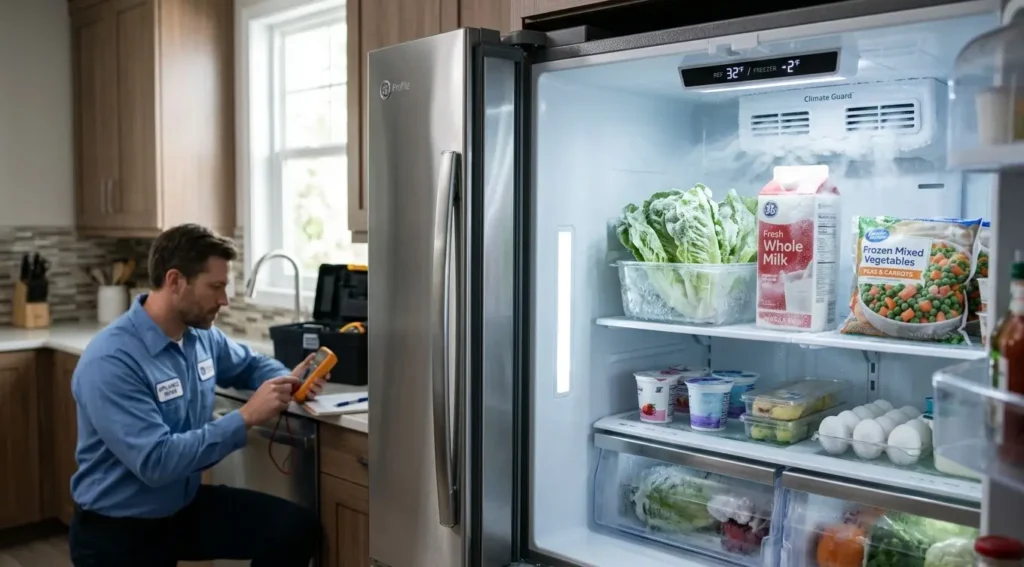
If your GE refrigerator freezing food in the fresh food section, the most likely causes are a faulty temperature control thermostat, a malfunctioning damper control assembly, incorrect temperature settings, or a defective thermistor. In most cases, you can diagnose the problem yourself, but some fixes require a professional technician to avoid further damage to your appliance.
This is one of the most frustrating refrigerator problems homeowners deal with. You open the fridge expecting fresh vegetables and cold drinks, only to find your lettuce is frozen solid and your milk has ice crystals in it. The good news is that this issue is well understood, and there are clear reasons why it happens.
Why Is My GE Refrigerator Freezing Everything in the Fresh Food Compartment?
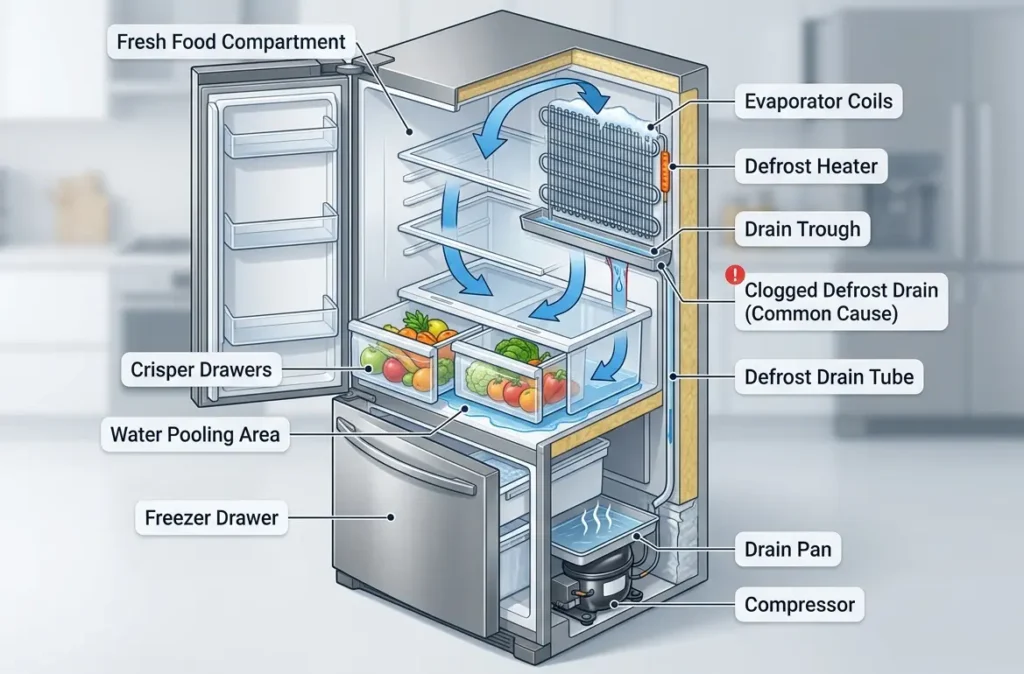
Before jumping into fixes, it helps to understand how your GE refrigerator actually manages temperature. The fresh food section and the freezer share a single cooling system. Cold air is produced in the freezer evaporator and then moved into the fresh food section through a damper or air diffuser. If anything in that chain malfunctions, the fresh food compartment can get overwhelmed with cold air and start freezing your groceries.
Here are the most common culprits.
1. Temperature Settings Are Too Low
This sounds obvious, but it is often overlooked. GE recommends setting the fresh food section between 35°F and 38°F (1.6°C to 3.3°C). If someone accidentally bumped the dial or the digital control panel was reset after a power outage, the temperature may be set much lower than intended.
Check the control panel and confirm your settings are within the recommended range. On newer GE models with digital displays, the fresh food temperature is typically shown separately from the freezer. On older dial models, the refrigerator control is usually numbered 1 through 9, with higher numbers meaning colder temperatures.
2. Faulty Temperature Control Thermostat
The temperature control thermostat is the component that monitors the air temperature inside the fresh food section and signals the compressor and evaporator fan to cycle on and off. When this thermostat fails, it can get stuck in the “on” position, telling the refrigerator to keep cooling indefinitely. The result is a fresh food compartment that never warms back up to the correct temperature.
To test this component, rotate the thermostat dial from the lowest to the highest setting and listen for a click. If you hear no click, the thermostat is likely defective and needs replacing. This is a relatively affordable repair, but it does require accessing internal components.
3. Damper Control Assembly Is Stuck Open
The damper (also called the air diffuser or baffle) is a small door-like component that controls how much cold air flows from the freezer into the fresh food section. On most GE refrigerators, this damper opens and closes automatically based on the thermostat’s signal.
If the damper becomes stuck in the open position, it allows a constant rush of freezing cold air into the fresh food section. This is one of the most direct causes of food freezing in the refrigerator compartment. Dampers can get stuck due to ice buildup, a broken actuator, or a failed bi-metal strip.
You can usually find the damper at the top or back of the fresh food section. If you see it sitting fully open at all times, that is a strong indicator it needs to be replaced.
4. Defective Thermistor (Temperature Sensor)
Modern GE refrigerators use a thermistor rather than a mechanical thermostat. The thermistor is an electronic sensor that measures the temperature and sends data to the main control board. If the thermistor fails or sends inaccurate readings, the control board may continuously run the cooling system, which leads to temperatures dropping too low in the fresh food section.
A technician can test the thermistor’s resistance with a multimeter. If the resistance does not match the expected range for your model’s temperature, the thermistor needs to be replaced.
5. Main Control Board Malfunction
The main control board acts as the brain of your GE refrigerator. It processes signals from the thermistor and thermostat and regulates the compressor, fans, and defrost system accordingly. A defective control board can misread temperature data and over-cool the fresh food compartment.
Control board issues are less common than thermostat or damper problems, but they do occur, especially in older units or after power surges. If you have already ruled out other causes, the control board may be the issue. This is generally not a DIY repair and requires a trained appliance technician.
6. Blocked Air Vents Inside the Refrigerator
The vents inside your GE refrigerator distribute cold air evenly throughout the compartment. If food items are placed directly against these vents, the airflow becomes restricted and then concentrated in certain spots, which can cause those areas to get extremely cold and freeze nearby food.
Check the interior of your fresh food section and make sure nothing is blocking the air vents, particularly the vents located at the back wall. Rearranging your food to allow proper air circulation is a simple fix that can make a significant difference.
7. Worn Door Gaskets
A damaged or deteriorated door gasket on the fresh food section can let in warm, humid air. This causes the refrigerator to work harder and run longer to compensate, which can result in overcooling. Additionally, moisture from the warm air can create frost and ice around the vents, which further disrupts temperature control.
Run your hand along the door seal and feel for any gaps, tears, or sections that feel loose. You can also perform the dollar bill test: close the door on a dollar bill and try to pull it out. If it slides out easily, the gasket is not sealing properly.
8. Defrost System Problems
GE refrigerators use an automatic defrost system that includes a defrost heater, defrost thermostat, and defrost timer or control board. If any part of this system fails, frost can accumulate on the evaporator coils. A thick layer of frost on the evaporator restricts normal airflow, which causes the refrigerator to run longer and can push temperatures below the desired range in the fresh food section.
Common signs of a defrost system failure include ice buildup at the back of the freezer, food freezing in the fridge, and the refrigerator running almost constantly.
Professional GE Refrigerator Diagnostics & Repair
How to Troubleshoot a GE Refrigerator Freezing Food: Step by Step
Here is a practical troubleshooting process you can follow before calling a technician.
Step 1: Check and adjust the temperature settings. Set the fresh food section to 37°F and the freezer to 0°F and wait 24 hours to see if temperatures stabilize.
Step 2: Clear all vents inside the refrigerator and avoid placing food items directly against the back wall or near the air diffuser.
Step 3: Inspect the door gaskets for damage. Clean them with warm soapy water, as debris can prevent a proper seal.
Step 4: Locate the damper or air diffuser (usually at the top back of the fresh food section) and check if it appears stuck open.
Step 5: Listen to the compressor. If it is running constantly without cycling off, this points to a thermostat, thermistor, or control board issue.
Step 6: Check the freezer section for excessive frost buildup on the back wall, which can indicate a defrost system failure.
If you complete these steps and the problem persists, it is time to bring in a professional. Continuing to use a malfunctioning refrigerator can cause permanent damage to the compressor or control board, which turns a moderate repair into an expensive replacement.
GE Refrigerator Models Commonly Affected
While this issue can affect any GE refrigerator, it is frequently reported in models from the GE Profile and GE Cafe series, as well as older top-freezer and bottom-freezer configurations. French door models with separate temperature zones can also experience this problem when the damper between zones malfunctions.
If you own a GE Adora, GE Artistry, or an older GE side-by-side model, the damper assembly and thermostat are the most common failure points to investigate first.
When to Call a Professional Appliance Repair Technician
DIY troubleshooting goes a long way, but certain repairs should always be handled by a certified technician. You should call a professional if:
The temperature continues to drop even after adjusting settings and clearing vents. You suspect the thermistor, control board, or sealed system components are involved. You notice the compressor running non-stop or hear unusual clicking or buzzing sounds. You see ice forming on the evaporator coils inside the freezer compartment. The refrigerator is under warranty and you want to avoid voiding it.
For residents in the Fargo, North Dakota area and nearby communities, professional help is close by. The team at Fast Fix Appliance Repair Fargo offers expert refrigerator repair services in Fargo with same-day diagnostics and genuine replacement parts. Whether it is a damper issue, a bad thermistor, or a control board problem, certified technicians can quickly identify the root cause and restore your refrigerator to proper working condition.
How to Prevent Your GE Refrigerator from Freezing Food in the Future
Prevention is always better than repair. Here are a few habits that will keep your GE refrigerator running efficiently and protect your food from freezing.
Maintain proper temperature settings year-round. Seasonal changes can affect how hard your refrigerator has to work. Check settings twice a year.
Do not overpack the refrigerator. Overpacking restricts airflow and forces the cooling system to work harder, which can cause uneven temperatures.
Clean the condenser coils every six months. Clean the condenser coils every six months. Dirty condenser coils reduce efficiency and force the compressor to work longer. For a deeper understanding of how condenser coils, compressors, and evaporator coils affect refrigerator performance, check out this comprehensive refrigerator guide.
Check door seals regularly. Replace gaskets at the first sign of cracking or loosening.
Schedule annual maintenance. A professional inspection once a year can catch small issues before they become expensive problems.
Is It Worth Repairing or Should You Replace Your GE Refrigerator?
This is a question many homeowners wrestle with. As a general rule, if the repair cost is less than 50 percent of the cost of a new refrigerator and the unit is under ten years old, repair is usually the smarter financial choice. GE refrigerators are built to last 14 to 17 years with proper care, so a mid-life repair is almost always worth it.
If your unit is older than 12 years and needs a compressor replacement or major sealed system repair, replacing the unit may be more cost-effective in the long run.
For a professional assessment of whether your GE refrigerator is worth repairing, the experts providing fridge repair service in Fargo at Fast Fix Appliance Repair can give you an honest evaluation with no pressure to upsell unnecessary parts or services.
Understanding GE Refrigerator Temperature Controls
GE has used different types of temperature control systems across its product lines over the years. Understanding which system your model uses can help you diagnose problems more accurately.
Mechanical thermostat models use a dial system typically numbered 1 through 9. These are simpler to test and replace.
Electronic control board models use digital displays and thermistors. These are more precise but also more complex to diagnose without proper tools.
Dual evaporator models (found in some GE French door refrigerators) have separate cooling systems for the fresh food and freezer sections. In these models, a freezing problem in the fresh food section is often traced to the fresh food evaporator or its dedicated thermostat.
According to the U.S. Food and Drug Administration (FDA), refrigerators should be kept at or below 40°F (4°C) to prevent bacterial growth, but temperatures should not drop below 32°F (0°C) in the fresh food section, as this begins to freeze food and damage its cellular structure.
Final Thoughts
A GE refrigerator freezing food in the fresh food section is a solvable problem in nearly every case. The issue almost always comes down to one of a handful of components: the temperature control thermostat, the damper assembly, the thermistor, the defrost system, or the main control board. Start with the simplest explanations first, which are settings and airflow, and work your way toward more complex component failures.
If you are in the Fargo, ND area and need a reliable, experienced appliance repair team, Fast Fix Appliance Repair Fargo is ready to help. From diagnosing a stubborn freezing problem to replacing faulty components, the team brings the expertise needed to get your GE refrigerator back to perfect working order.
Get Expert Help to Fix Your GE Refrigerator Freezing Issue Today